
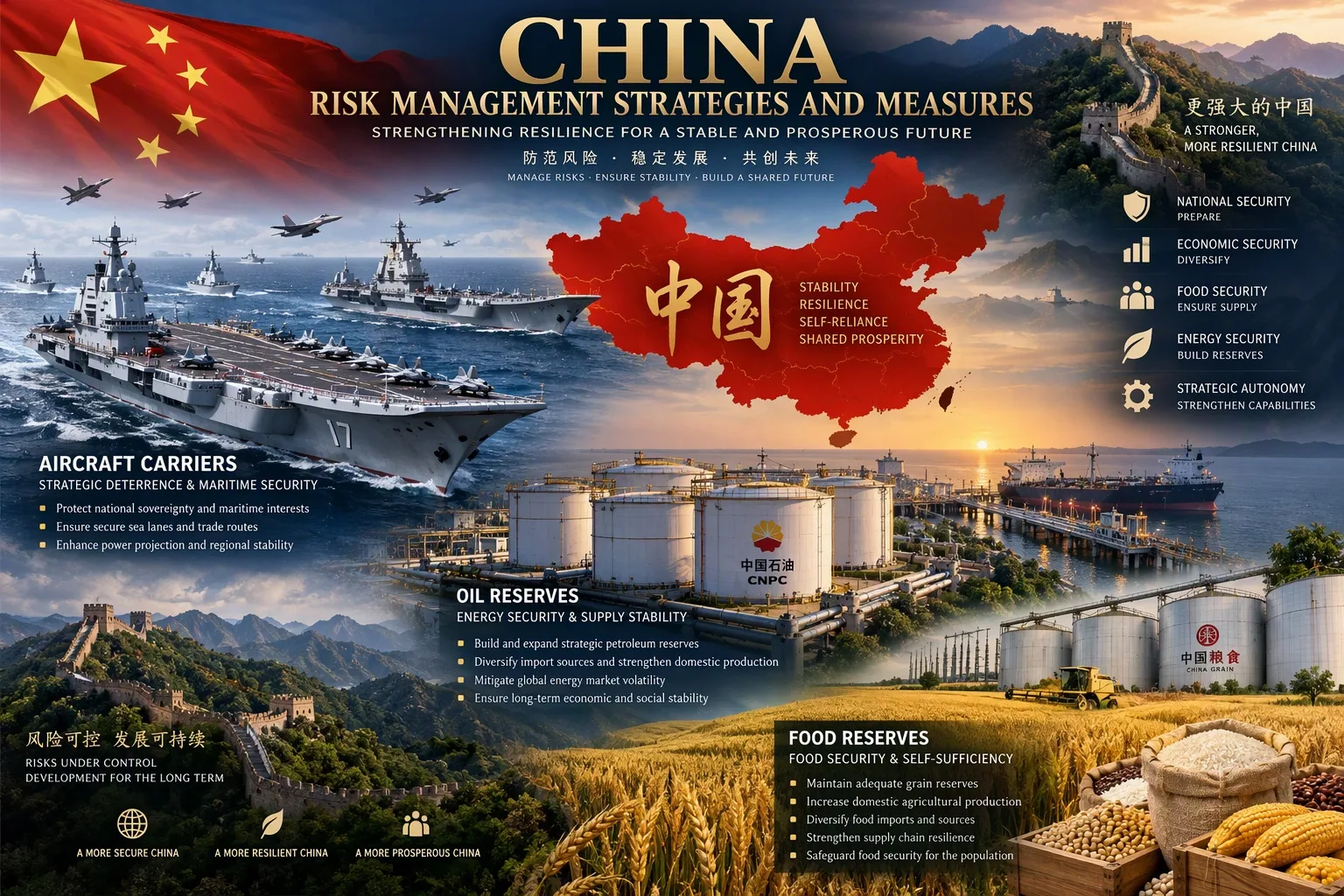
| The war in the Middle East clarifies the risk profile of the three main players present in the region: Iran, China, and the USA with its military fleet. In this fifth part of a mini-series, I outline aspects of China’s risk profile – Risk management strategies and measures. | In this contribution, I am writing my own opinion, not that of any organization. |
Author: Manu Steens
Table of contents
A. General risk management strategies and frameworks
China’s primary risk management framework is the integrated doctrine of ‘national total war,’ which treats all state resources—economic, military, diplomatic, and technological—as instruments of national security. The National Security White Paper of May 2025 (‘China’s National Security in the New Era’) formalized for the first time the subordination of economic growth to security priorities, anchoring risk management in every dimension of state operations. The 15th Five-Year Plan (2026–2030) implements this through ‘ New Quality Production Forces’ —state-driven investments in AI, quantum computing, semiconductors, and green energy as risk-hedging investments against Western technological leverage.
The National Disaster Reduction Committee (based at the Ministry of Emergency Management since 2018) coordinates China’s multi -hazard disaster risk reduction framework , which has evolved from reactive response to proactive risk management since the 11th Five-Year Plan (2006-2010). The Global Facility for Disaster Reduction and Recovery documents China’s transformation: a significant improvement in disaster prevention mechanisms, disaster monitoring and information processing, and extensive risk prevention capabilities over the past 15 years.
B. Insurance equivalents and financial buffers
CURRENCY RESERVES
China possessed $3.438 trillion in total foreign exchange reserves by the end of August 2026 — the largest in the world and the highest level since 2015. This is China’s most important financial insurance instrument: a buffer against currency attacks, external payment shocks, and capital flight. Unlike the US Federal Reserve, China does not have a lender of last resort relationship with the global financial system, making its own reserve holdings a more important direct insurance mechanism. In recent years, China itself has transformed into an informal, global lender of last resort .
STATE-CONTROLLED FISCAL TOOLKIT
China’s total capacity and directly activated resources to deploy large-scale, centrally targeted fiscal stimulus measures includes a core package of 10 trillion yuan (approximately 1.4 trillion dollars). This specific multi-year stimulus and restructuring program has been approved by the government to restore financial clout and support the economy. China’s ‘broad’ or ‘expanded’ budget deficit (often referred to as the augmented fiscal deficit ), including all financing outside the official budget, is estimated by research agencies and credit rating agencies at approximately 9.0% to 10.0% of gross domestic product (GDP) — which represents the available scale of state insurance capacity for economic shocks.
LOCAL AUTHORITIES DEBT SWAP PROGRAM
Beijing launched a massive and structured debt swap program to mitigate the acute financial risks of local governments — hidden local government liabilities estimated at 90–110 trillion yuan ($12–15 trillion). The Asia Society ’s assessment of China 2026 notes that this provided “temporary relief” and functions as an emergency insurance mechanism to prevent cascading defaults among local governments — the most direct systemic risk in China’s financial architecture.
C. Diversification measures
DIVERSIFICATION OF ENERGY SOURCES — RENEWABLE ENERGY
China’s most far-reaching diversification measure is its dominant position in the production and deployment of renewable energy. By 2025-2026, China is estimated to possess more than 80% (and for certain parts of the chain up to around 87% to 90%) of global solar panel production capacity and is the world’s largest installer of wind energy . The closure of the Strait of Hormuz in April 2026 demonstrated the value of this strategy in real time: China’s significant renewable capacity and strategic reserves ‘enabled normal economic activity to continue without crisis-level intervention’ despite the disruption of global oil supply routes. China is also aggressively electrifying its vehicle fleet. The International Energy Agency (IEA) and other analysts initially predicted that Chinese oil demand would peak around 2027 , driven by the rise of electric vehicles ( EVs ) and a faster high-speed rail network — thereby reducing dependence on energy imports over time. According to more recent insights, oil demand in China has likely peaked before 2027.
TRADE ROUTE AND DIVERSIFICATION OF PARTNERS
China diversified its export markets and trade routes to reduce concentration risk. Following the US tariff increase in 2025, China successfully ‘found new export markets, while imports remained limited’. The Belt and Road Initiative , which now includes more than 140 countries, offers alternative economic channels. China has also established land connections with Europe (China-Europe Railway Express) and deepened trade with ASEAN , which overtook the US in 2020 as China’s largest trading partner. Membership in SCO and BRICS expands economic relations beyond the US-dominated financial architecture.
TECHNOLOGY INDIGENISATION
China’s Made in China 2025 and successor programs aim to draw critical technology sectors—semiconductors, aerospace, AI, biotechnology—into China to reduce dependence on Western-controlled supply chains. The Private Economy Promotion Law of 2025 was intended to reassure domestic entrepreneurs and rebuild the private sector’s contribution to this diversification. Export restrictions on gallium, germanium, and rare earth metals constitute the offensive dimension of this diversification: they create leverage against adversaries dependent on China-controlled critical minerals.
D. Emergency funds and reserves
STRATEGIC PETROLEUM RESERVE
By early 2026, China is estimated to possess 1.1–1.3 billion barrels of total crude oil stocks — the world’s largest emergency oil reserve, even higher than the US SPR. This includes approximately 400–500 million barrels in dedicated government SPR facilities (providing approximately 90–120 days of net import coverage) and 668 million barrels of commercial stocks managed under state supervision. A law of January 2025 formalized the integration of government and commercial stocks into a single national reserve framework. China is actively expanding capacity by adding at least 169 million barrels of new storage at 11 locations in 2025–2026, with an average stockpile of approximately 530,000–1,000,000 barrels per day. The EIA projects that China will continue to build strategic reserves at a rate of approximately 1 million barrels per day until 2026.
FOOD RESERVES
China manages the world’s largest government grain reserves , holding an estimated 50–69% of global maize reserves and, according to some estimates, more than 50% of global wheat reserves, managed by the National Food and Strategic Reserves Administration. These reserves constitute a direct emergency fund for food security risks—a crucial priority, given that food price inflation and supply disruptions have historically been the causes of social instability in China. The 15th Five-Year Plan includes food security as a top strategic objective.
E. Security measures
INTERNAL SECURITY — SOCIAL STABILITY APPARATUS
China maintains the world’s most extensive domestic security apparatus. The Ministry of Public Security, the Ministry of State Security, and the CCTV-based surveillance network (the ‘Skynet’ and ‘Sharp Eyes’ systems, with an estimated 600 million cameras by 2025) provide comprehensive internal security coverage. The ‘Great Firewall’ regulates information flows and prevents the dissemination of destabilizing narratives. Internet content is managed by the Cyberspace Administration of China. Social credit systems at the provincial level provide behavioral management tools. Collectively, these constitute China’s key internal risk management measures against social instability.
MILITARY SECURITY — MODERNIZATION OF THE PLA
China’s military modernization program constitutes the most important external security measure. The DoD ‘s 2025 report to Congress confirms that China is ‘advancing on the Centennial Military Building Goal for 2027’ with a growing arsenal of naval units, hypersonic missiles, anti-satellite weapons, and nuclear warheads. The People’s Liberation Army Navy now operates three aircraft carriers and a large surface fleet. China’s nuclear arsenal is expanding to more than 500 warheads, aiming to create a more credible second-strike deterrent. The Rocket Force maintains medium-range ballistic missiles and provides area defense of the Western Pacific as a defensive measure.
CYBER AND INFORMATION SECURITY
The Cyberspace Administration of China and the PLA Strategic Support Force cyber units operate as both defensive and offensive cyber capabilities. MERICS notes that Xi Jinping has strived for ‘ever greater secrecy regarding science, technology, and the economy,’ with cybersecurity embedded in the integrated national strategic system. Technically, China does not manage its domestic internet infrastructure entirely independently of global DNS systems , but it does exercise extreme, centralized, and autonomous control over it. Export controls on rare earth metals used in semiconductors serve as a cyber-related technological security measure.
F. Emergency plans
China’s most important formal emergency document is the annual decision of the Central Economic Work Conference, which sets macro policy parameters for the coming year and contains emergency provisions for the escalation of trade wars, financial instability, and natural disasters. For 2026, the conference has pre-approved ‘moderately loose’ monetary policy measures and proactive fiscal policy, thereby creating a pre-positioned emergency response toolkit. The Asia Society’s ‘China 2026: What To Watch’ identifies Beijing’s five strategic strategies to manage external pressure in 2026: trade agreement negotiations; market diversification; technology indigenization; geopolitical reorientation; and information management — each represents a pre-planned emergency solution. The debt swap program is itself an emergency instrument activated in anticipation of fiscal failure by local governments.