
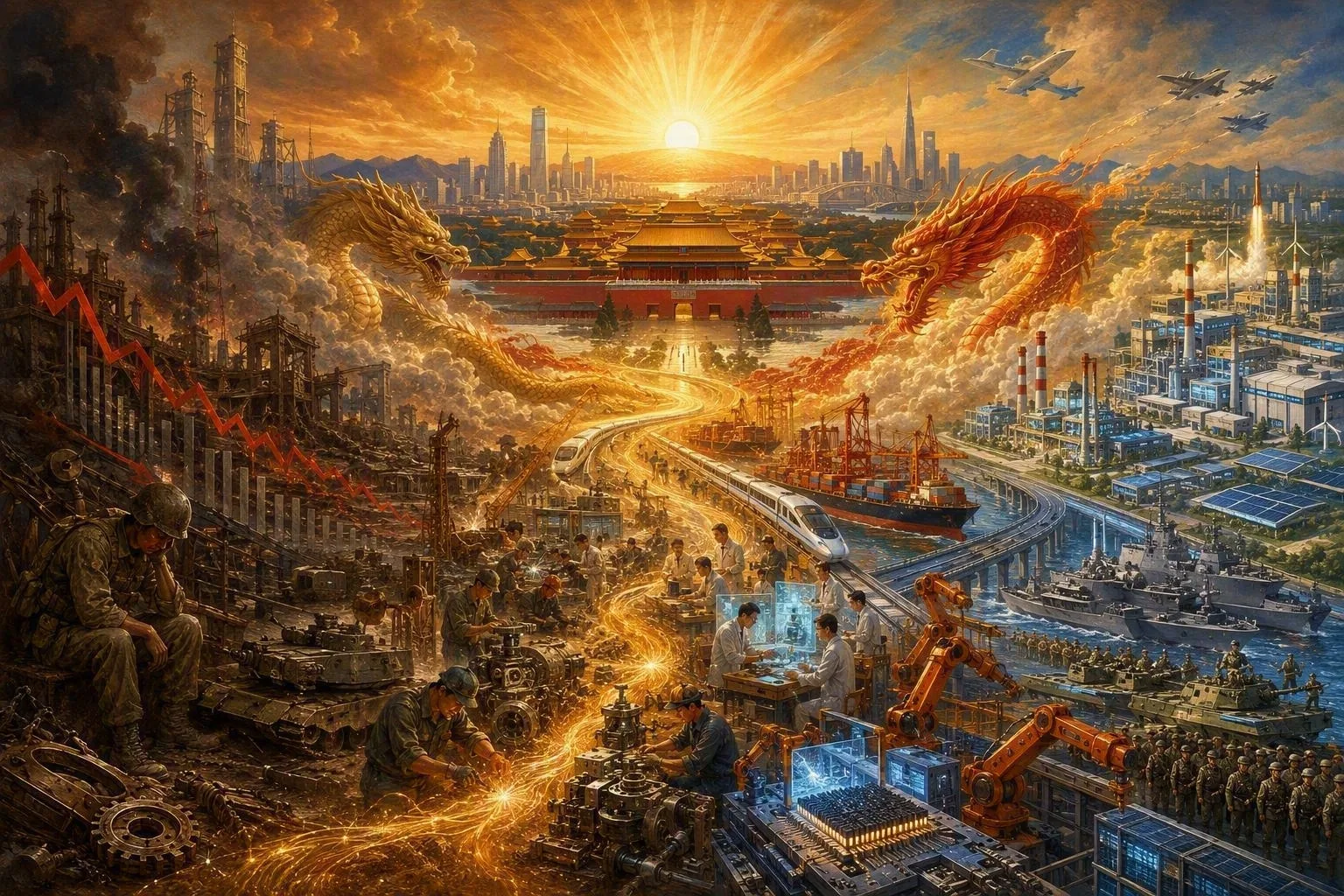
| The war in the Middle East clarifies the risk profile of the three main players present in the region: Iran, China, and the USA with its military fleet. In this third part of a second mini-series, I outline aspects of China’s risk profile – absorption of loss and recovery of resources. | In this contribution, I am writing my own opinion, not that of any organization. |
Author: Manu Steens
Contents
Ability to absorb losses
FINANCIAL LOSS RECOGNITION
China can absorb financial losses well, partly thanks to substantial state support. In September 2025, China had 3.3387 trillion dollars in foreign exchange reserves — the highest level since 2015. That is a substantial buffer against external economic shocks. In its 2025 report, the IMF confirms that banks generally have sufficient capital and money on hand, that the strongest banks can withstand severe economic shocks, and that most businesses and households are in a healthy financial situation.
However, China also has weaknesses that limit its ability to absorb losses. By mid-2025, total debt in China had risen to 30 % of GDP . Among the major economies, only Japan has a higher debt ratio. According to Carnegie As a result, China stands out even more than Japan regarding Endowment , because it is a middle-income country. If the real estate sector collapses more deeply than expected, this, combined with high debt, could lead to a negative spiral larger than the state can absorb.
MILITARY LOSS RECORDING
A report from the U.S. Department of Defense (2025) to Congress confirms that China continues to make progress toward its 2027 military goal, despite major purges within the military leadership. The Chinese military (PLA) possesses a large and growing arsenal: nuclear weapons, naval vessels, conventional long-range weapons, cyber capabilities, and aerospace technology. Researchers at the Harvard Fairbank Center conclude that one must look at this entire ‘forest’ of growing capabilities, not just the ‘fallen trees’ (the purges) — the purges cause unrest, but have not stopped the growth of military power.
China’s highest military strategy is based on the idea of a ‘total war of the entire nation’: in the event of a major conflict, all state resources can theoretically be deployed. On paper, this gives China a greater capacity to absorb losses than the official defense budget suggests. However, this idea has never been tested in a modern, major conflict. Therefore, how well the Chinese army truly holds up in a prolonged struggle has not yet been proven.
INSTITUTIONAL LOSS ABSORPTION
Xi Jinping ‘s government can absorb and control the political consequences of losses better than democracies can, for example, by controlling information, adjusting the nationalist narrative, and avoiding accountability. In the short term, this provides extra room to absorb losses. However, the Foreign Policy Research Institute warns that this rigid approach— Xi’s concentration of power, the sidelining of expert officials, and rewarding loyalty over competence—actually diminishes adaptability, precisely when losses call for adjustment. Moreover, because there is no clear succession plan, heavy losses could lead to a power struggle within the party leadership, with repercussions for the entire system.
B. Means to reduce or remedy adverse outcomes
ECONOMIC INSTRUMENTS
China’s primary tool for recovering from setbacks is its fiscal and monetary policy, which is heavily state-controlled. For 2026, the Central Economic Work Conference opted for a “ more proactive” fiscal policy and a “slightly more accommodative” monetary policy . This includes, among other things, $644.7 billion in local government bonds, $190.5 billion in long-term strategic bonds, and expanded special government bonds. According to the Congressional Research Service , China’s broader budget deficit, including off-budget support, will reach approximately 9.2% of GDP in 2026. This demonstrates how much money China can theoretically deploy to recover.
China’s domestic market of 1.4 billion people is in itself a tool for recovery: this size enables industrial reconstruction and recovery through domestic consumers, something smaller economies cannot do. The 15th Five-Year Plan ( 2026-2030 ) emphasizes ‘New Quality Productive Forces’ — such as AI, quantum computing , and green energy — as long-term means to remain competitive and recover. According to the Asia Society, Beijing’s broad approach helps prevent external shocks and ensures stability.
MILITARY RESOURCES
Due to the significant modernization of the Chinese military over the past decade, China now possesses far greater military resources to recover from losses. By 2025–2026 , the Chinese Navy will possess advanced destroyers comparable to Western warships, modern submarines, and a growing fleet of aircraft carriers. China holds approximately half of all global intelligence, surveillance, and reconnaissance (ISR) systems, enabling it to track U.S. and allied forces in the Indo- Pacific region. The Chinese nuclear arsenal is also growing, providing the ultimate deterrent against very heavy losses.
ALLIANCE AND PARTNERSHIP SOURCES
China has deepened its cooperation with Russia to what the Toda Peace Institute describes this as a ‘structured alignment’, reinforced by mutual interdependence in the fields of energy, growing defense cooperation, and increasingly aligned diplomatic positions. Russia offers China diplomatic support, energy, and cooperation on military technology. China, in turn, offers Russia access to capital and markets. This axis between Russia and China thus forms a mutual tool for recovery: both countries protect each other against economic pressure from the West. Additionally, China’s Belt and Road relations and its partnerships within the SCO (Shanghai Cooperation Organisation) and BRICS offer alternative economic networks should access to Western markets be lost.
TECHNOLOGICAL SOURCES
China’s digital infrastructure and investments in AI constitute an important tool for the future. The IMF notes that China’s digital infrastructure is well-prepared to derive significant benefits from AI. Through targeted government investments in semiconductors, electric cars, and green energy, China has become less dependent on Western technology imports. As a result, the country can recover more easily from disruptions in technological supply chains. However, China is not yet fully self-sufficient in the field of advanced semiconductors. This means that export restrictions on technology imposed by the US and its allies still constitute a significant constraint on China’s recovery capacity in the high-tech sector.