
| The war in the Middle East makes things clear about the risk profile of the three most important players in the region: Iran, China and the USA with its military fleet. In this fourth part of a mini-series, I outline aspects of China’s risk profile – risk exposure assessment. | In this contribution I write my own opinion, not that of any organization |
Author: Manu Steens
Contents
EXPOSURE TO ECONOMIC AND FINANCIAL RISK
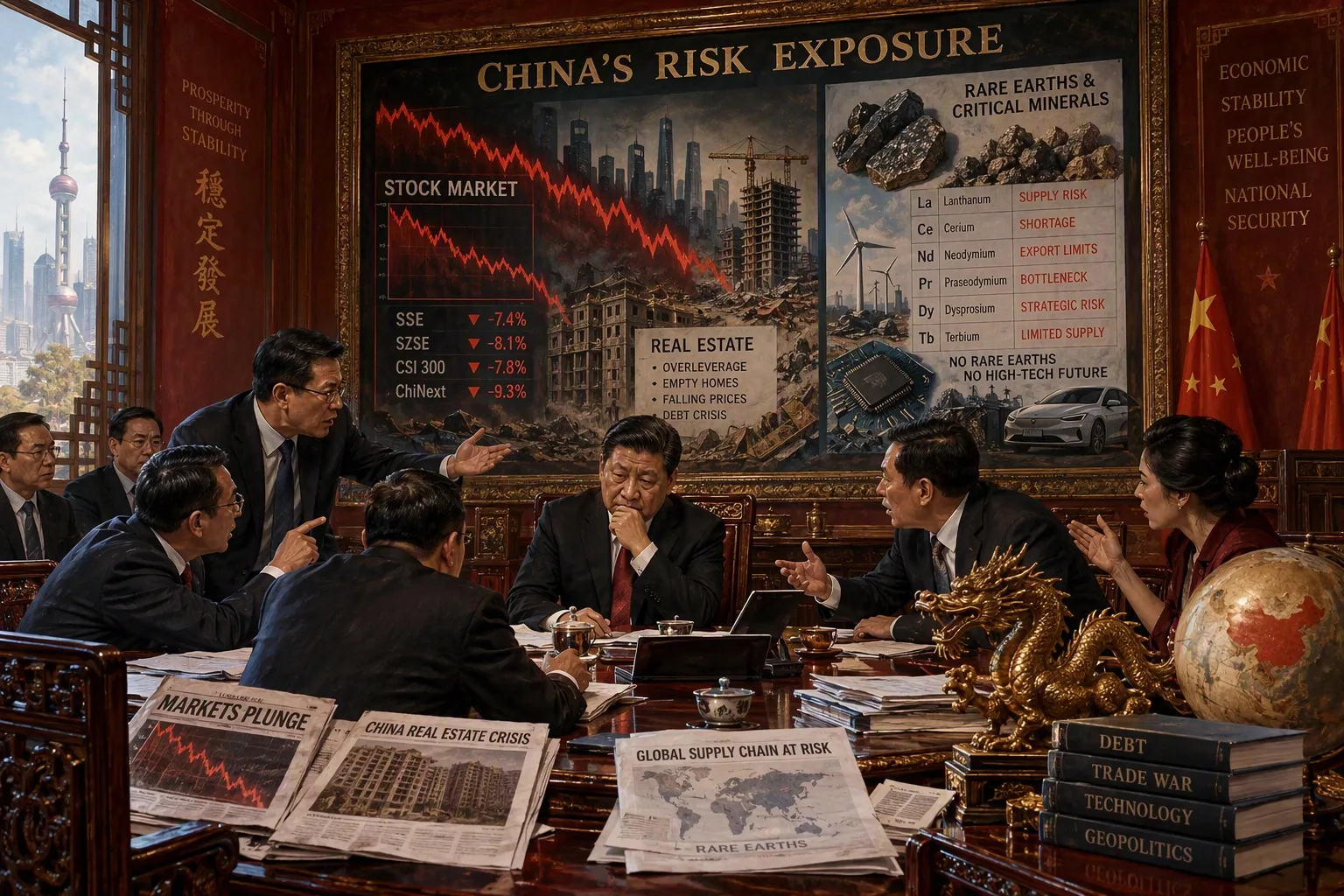
China’s economic risks mainly stem from three weaknesses that can reinforce each other. First, China’s total debt has risen to 309% of GDP. This makes China, as a middle-income country, even a bigger exception than Japan when it comes to debt to the economy. Researchers at CSIS show that the higher import tariffs introduced by President Trump in March 2025 put additional pressure on Chinese manufacturers that already operate with small profit margins — which means that some companies will probably no longer be able to repay their debts. In 2024, international bond issuance from Chinese issuers have reached USD141 billion, a 29% year-over-year increase, according to a report published by International Capital Market Association. The China offshore USD bond new issuance rose to approximately USD88.5 billion in 2024, representing a year-on-year growth of 42%. Both are sensitive to US investment restrictions and to US interest rate policy.
Second, the crisis in the real estate sector continues. According to a report by insurer Allianz , headwinds in the Chinese economy continued in 2024 and 2025, although this was partly offset by increased government support and strong exports. But the report warns that risks are actually increasing towards the end of 2026, as these windfalls ease and domestic demand remains weak. Consumer confidence remains low and investments in buildings and machinery, for example, have fallen. The IMF cites a deeper than expected decline in the real estate sector, combined with high debt, as the main risk to its own economy.
Third, China’s growth model, which relies heavily on exports, is vulnerable to the trade war with the US and technology decoupling. Research firm MERICS warns that U.S. import tariffs — which reached 130% for some product categories in October 2025 — have caused sharp declines in global stock markets and disruptions in supply chains. Because China accounts for 28% of the MSCI emerging market index, a disappointing Chinese economy also affects global investment flows. At the same time, the decoupling of semiconductors and advanced technology limits China’s future growth opportunities.
MILITARY AND GEOPOLITICAL RISK EXPOSURE
According to the US intelligence services (DNI, annual report 2026), China will probably continue to work on the conditions for eventual reunification with Taiwan in 2026, unless a conflict breaks out. These services estimate that Chinese leaders are not currently planning an invasion of Taiwan in 2027 and do not have a firm date for reunification — but the build-up of the army continues at a rapid pace. The risk for China around Taiwan works both ways: if the country intervenes, severe economic and military consequences will follow; If it does not intervene while nationalist expectations are growing in its own country, it will actually put domestic pressure on the authority of the party.
China’s activities in the South China Sea pose a direct risk of military confrontation with the United States and its allies in the Indo-Pacific region. A report by Crisis24 (2026) mentions specific reasons for escalation: joint maritime patrols by the US and countries such as Australia, Japan and South Korea, the construction of military infrastructure on artificial islands, and unilateral exploration for energy in disputed waters. The World Economic Forum’s Global Risks Report 2026 notes that the actions of China and the US are the most closely monitored, as economic pressures are increasingly used as a weapon in broader geopolitical competition.
The Foreign Policy Research Institute points to a risk that China is actually creating itself: because the Chinese leadership sees waiting as dangerous — due to an aging population, debts and internal discontent — the same idea can actually lead to premature military action, miscalculations or policy that has gone too far. That could cause exactly the crisis that Beijing is trying to prevent. Because Xi Jinping has concentrated a lot of power and put expert officials aside, the quality of strategic advice to him has diminished. As a result, the chance of wrong decisions under pressure has increased.
EXPOSURE TO TECHNOLOGY AND SUPPLY CHAIN RISKS
The biggest technological risk for China lies with advanced semiconductors (chips). The U.S. export restrictions on chips and chip machines, which have become increasingly strict since 2022, limit China’s access to the most advanced chips needed for AI and military systems. MERICS notes that in addition to Xi’s growing emphasis on security in science, technology and economics, Beijing is moving towards an “integrated national strategic system.” Still, it will take years before China is self-sufficient in advanced chips. This poses a structural weakness in the timeline of China’s military modernization and in the competition with the US in the field of AI.
China’s own export restrictions — for example, on gallium, germanium and rare earths — work both ways: if the US and its allies respond with countermeasures, it could accelerate the decoupling of supply chains. This would actually give China less access to the markets and technologies on which its own growth model depends. The Centre for China Analysis mentions a combination of risks: declining confidence in China, increasing economic headwinds, ongoing political purges, growing social discontent and a deteriorating international environment.
EXPOSURE TO DOMESTIC POLITICAL AND SOCIAL RISK
The domestic risk for China mainly focuses on the trade-off between a slowing economy and the legitimacy of the party. Youth unemployment is above 20% and consumer confidence remains low. Researchers at the University of Toronto explain that, as economic growth slows, the economic base of the Communist Party’s power begins to crack. Nationalism then jumps in to fill that gap. But that nationalist feeling, once stirred up, can also turn against the party leadership if it does not come across as assertive enough towards foreign countries. This creates a difficult situation in which reducing tensions can become very expensive politically.