
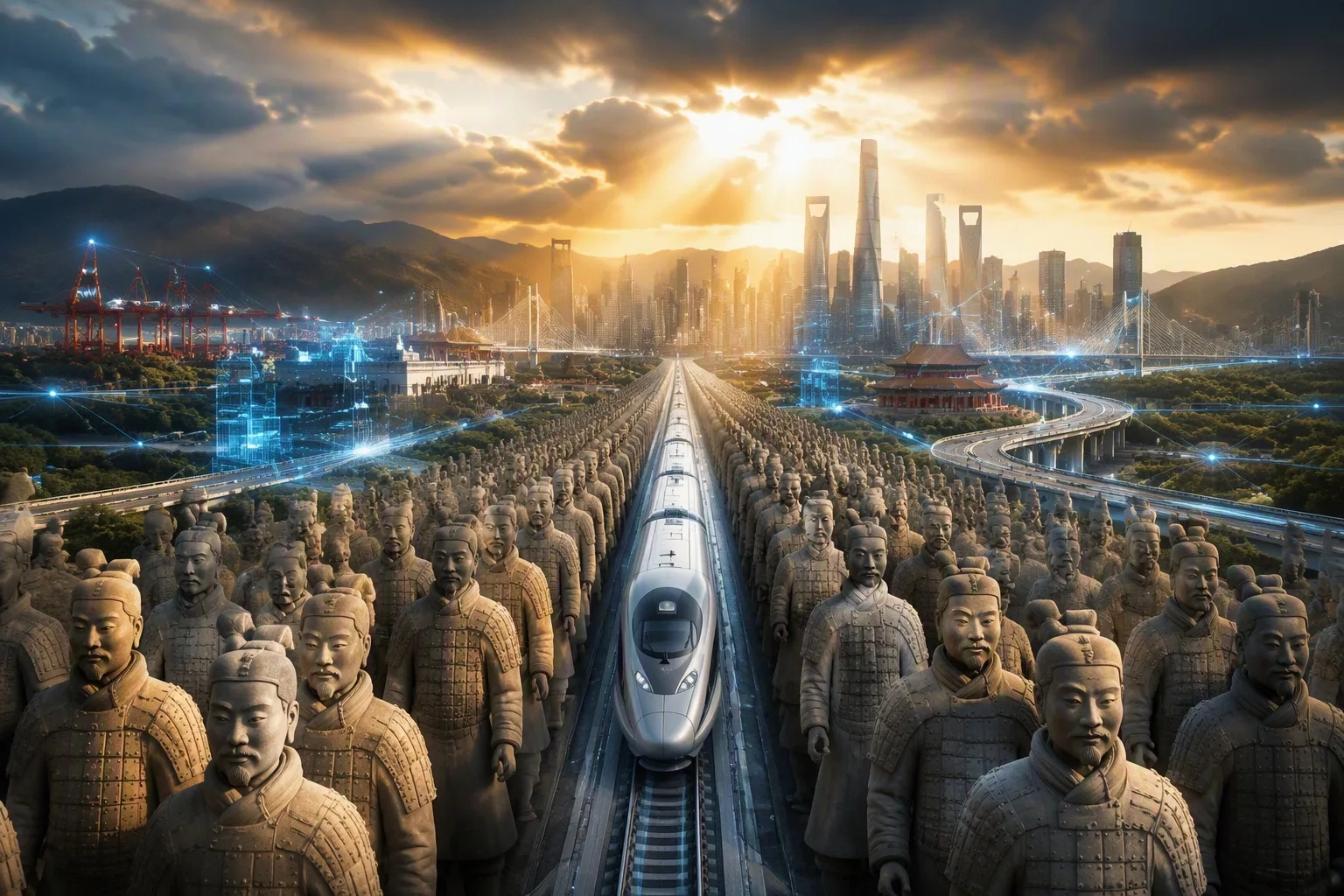
| The war in the Middle East makes things clear about the risk profile of the three most important players in the region: Iran, China and the USA with its military fleet. In this second part of a second mini-series, I outline aspects of China’s risk profile – their resilience and risk capacity. | In this text I give my own opinion, not that of any organization. |
Author: Manu Steens
Contents
A. Financial resilience — How well can China absorb economic consequences?
The Chinese economy has held up well over the past five years, despite multiple blows at once: the coronavirus pandemic, the real estate crisis, and increasing trade tensions. In its 2025 report, the IMF forecasts economic growth of 5.0% in 2025 and 4.5% in 2026. According to the IMF, China accounted for approximately 30% of global economic growth over the past three years. China’s enormous market of 1.4 billion people and approximately 190 million companies ensures strong internal stability.
A major study of the Chinese banking sector (2025) revealed that banks generally have sufficient capital and funds on hand. The strongest banks can even withstand severe economic shocks, and most businesses and households are in a healthy financial situation. Moreover, the Chinese government has established a major support program: 1.3 trillion yuan in special government bonds, intended to support important projects and encourage people to spend more.
However, China also has major weaknesses. By mid-2025, total debt in China (government, corporate, and household debt combined) had risen to 309% of GDP — compared to 303% at the end of 2024 — while the economy itself grew by only 4.1%. Research by the Carnegie Endowment shows that among the major economies, only Japan has a higher debt ratio. Because China is a middle-income country, this makes it stand out even more than Japan. The IMF warns that China urgently needs to address ‘old debts,’ the unsustainable debts of local governments, and the prolonged crisis in the real estate sector. That crisis is causing persistently weak demand in its own economy and falling price pressure (deflation).
Assessment: China therefore possesses significant financial resilience, partly because the government wields considerable influence and can decide independently to invest or borrow money. However, the growing mountain of debt and persistent price pressure are genuine long-term problems. They limit how much China can continue spending should a conflict or crisis last for a long time.
B. Societal and emotional resilience — How well can China absorb social and political stress?
The power of the Communist Party of China (CCP) rests on two pillars: successful economic results and nationalist sentiment among the population. Researchers at the University of Toronto explain that since the 1980s, the CCP has justified its power through economic success: the party offers prosperity in exchange for political control. But now that economic growth is slowing, this foundation is beginning to show cracks. Nationalism is increasingly filling the void left by the faltering economy.
Research by the Dutch institute HCSS (2025) shows that China primarily uses nationalist sentiments to strengthen the country internally around the authority of the Communist Party — not so much to turn against foreign countries, as is more common in Western countries. However, this is a risky strategy: if people feel that the party is not acting strongly enough towards foreign countries, those same nationalist sentiments could turn against the party itself. High youth unemployment (over 20%) and a growing sense of despondency among young people put this narrative under additional pressure.
Under Xi Jinping, the party has heavily concentrated its political power and sidelined potential rivals. As a result, the party leadership appears united, albeit only on the surface. However, the Foreign Policy Research Institute warns that this rigid approach—Xi’s concentration of power, the sidelining of expert officials, and the rewarding of loyalty over competence—actually diminishes China’s adaptability. Because critical voices within the party are silenced, it becomes more difficult to change course in time.
Assessment: In the short term, China’s societal resilience is therefore high, thanks to strict controls and the steering of nationalist sentiments. The risk in the medium term is that slower economic growth will undermine confidence in the party faster than nationalism can compensate — especially among younger generations who did not personally experience the prosperity of the economic reform era.
C. Stability threshold — How much risk is there before plans derail?
The stability of the Communist Party depends heavily on two things: the monopoly on the political narrative, and the promise of economic progress. The Foreign Policy Research Institute warns that Chinese leaders view waiting as dangerous—due to an aging population, debt, and internal discontent. As a result, the leadership may decide to take greater risks in the short term to achieve long-term goals, even if those risks are actually greater than what the system can truly handle.
According to research institute Brookings, Xi has redistributed his risks: he deliberately takes risks when reforming the domestic economy, but tries to keep external risks well under control. However, that approach has limits. A misjudgment regarding Taiwan, a financial crisis caused by the collapsing debt of local governments, or a severe blow to exports affecting both growth and employment — all of these could jeopardize the stability of the party. The IMF identifies a deeper-than-expected downturn in the real estate sector, combined with high debt, as the greatest risk to the domestic economy. This could lead to weaker domestic demand and persistently falling prices.
Assessment: China’s plans can therefore withstand significant external pressure, as was seen during the trade war with the US. However, if multiple problems go wrong simultaneously — such as economic growth, the real estate sector, exports, and Taiwan — that would constitute a threshold where the planned strategy would truly derail. Moreover, the Communist Party has no clear succession plan. This means that major instability could also lead to a power struggle within the party leadership, with consequences that no one can precisely predict.