
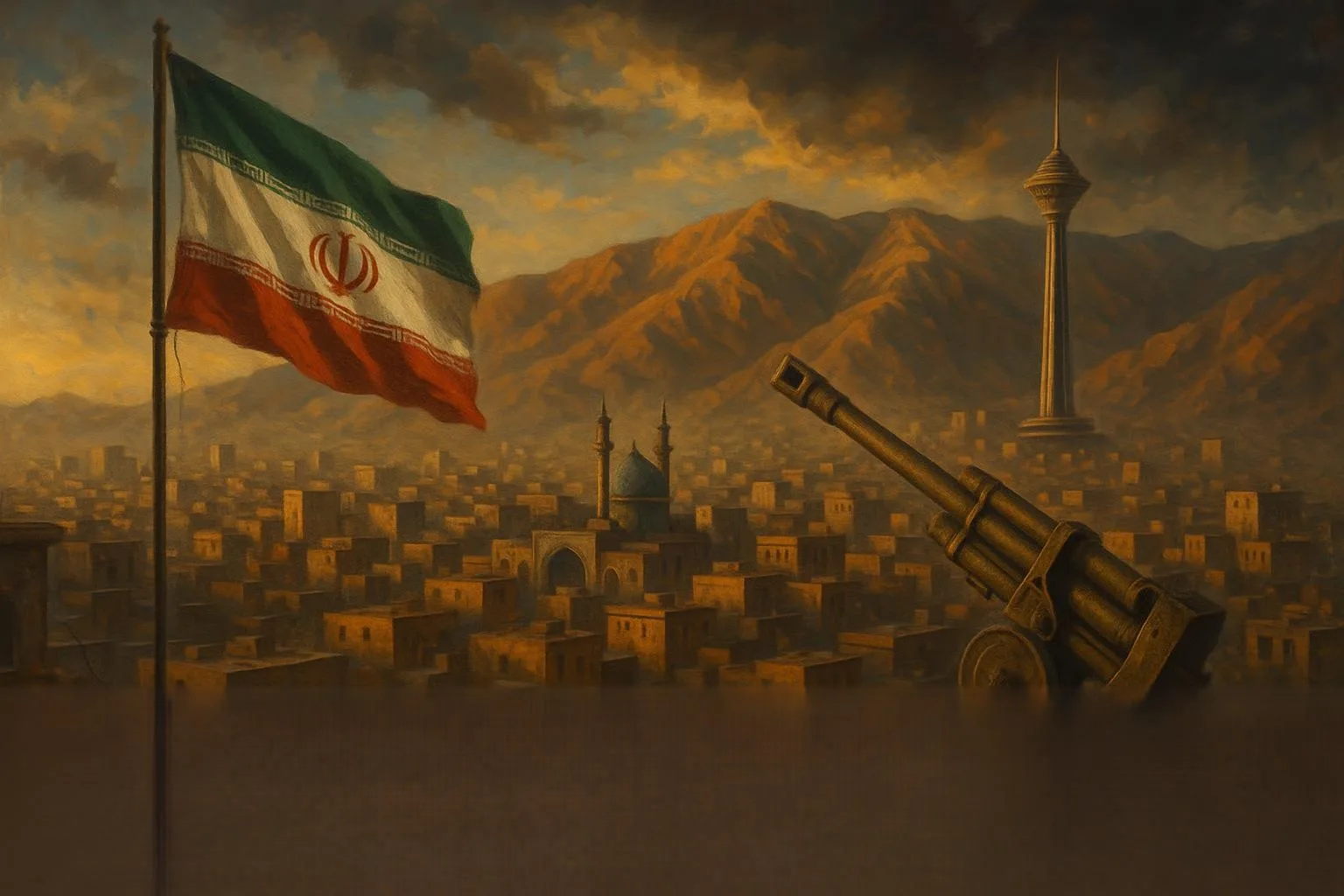
| The war in the Middle East clarifies the risk profile of the three main players present in the region: Iran, China, and the USA with its military fleet. In this fourth part of a mini-series, I outline aspects of Iran’s risk profile – risk exposure assessment. | In this contribution I write my own opinion, not that of any organization. |
Author: Manu Steens
Table of contents
A. Specific risk exposure of Iranian activities, operations, and investments
1. EXPOSURE TO MILITARY AND NUCLEAR RISKS
The greatest direct risks to Iran in 2025-26 stem from its own activities. The 12-day war of June 2025, in which Israel and the United States carried out attacks on Iranian nuclear infrastructure, missile production, air defenses, and IRGC command points, was directly linked to Iran’s nuclear program and its support for Hamas, Hezbollah, and the Houthis . According to the Congressional Research Service, these events have greatly reduced the advantages and influence that Tehran had built up over the years. The follow-up campaign Operation Epic Fury, in March 2026, subsequently focused further on rocket production, supplies, and launch capabilities.
According to the Institute for Science and International Security the June 2025 war severely damaged the infrastructure related to nuclear weapons and the capability to produce nuclear weapons. At the same time, much uncertainty remained after the war regarding what was left of the nuclear program, while the IAEA (International Atomic Energy Agency) had almost no monitoring left. Iran is now attempting to restore its missile capability through a strategy of ‘ deterrence through volume ‘: rebuilding large stockpiles of ballistic missiles to overwhelm Israeli and American defenses. That strategy itself also creates new risks, because it can provoke further preemptive attacks.
The 2026 DNI ATA stated that Iran has demonstrated the ability to prepare lethal operations against Americans at home and abroad. If the regime remains in power and can recover, according to that assessment, it will likely pursue such efforts again. The analysis also states that Tehran will almost certainly seek revenge for the death of Supreme Leader Ayatollah Ali Khamenei , and that it still has the long-term intention to avenge the death of former IRGC-QF commander Qasem to avenge Soleimani by targeting current and former US officials. Such retaliation plans also increase the risk for Iran itself, because they ensure that Iran remains a target.
2. ECONOMIC RISK EXPOSURE DUE TO SANCTIONS AND CONFLICTS
Iran also faces very significant economic risks. The Alma Institute reported in February 2026 that the economy was under severe pressure due to 60% inflation and a rial exchange rate of approximately 1,000,000 per dollar. The GDP contracted by 2.7% in 2025/26. Over the past decade, Iran lost an estimated 300 to 450 billion dollars in oil revenues. The reintroduction of UN snapback sanctions in September 2025 added further restrictions. Operation Epic Fury caused new physical damage to oil infrastructure in March 2026.
A major risk is that Iran is heavily dependent on China as an oil customer. China buys approximately 90% of total Iranian oil exports which peaked at 1.38 million barrels per day in 2025. This generates billions of dollars in annual revenue from China, including for the IRGC, despite US and UN sanctions. This dependence on a single buyer makes Iran vulnerable. If China were to buy less Iranian oil under US pressure, Iran could quickly find itself in financial trouble. Modern Diplomacy warned that such a decline in purchases could cause Iran’s export capacity to collapse and trigger a currency spiral.
3. EXPOSURE TO DOMESTIC INSTABILITY
Domestic risks for Iran increased sharply in 2025-26. Iran International wrote in January 2026 that prolonged economic exhaustion and a broader loss of confidence in the Iranian state could make 2026 the most difficult year ever for the Islamic Republic. That loss of confidence was also caused by military and foreign policy setbacks in 2025. By the end of 2025, protests had spread to all 31 provinces. They were driven by economic collapse, currency devaluation, and post-war disillusionment. The state responded with a near-total internet blackout and killed several hundred protesters.
International pressure also increased. On January 29, 2026, the EU designated the IRGC as a terrorist organization. This resulted in significant legal and reputational damage for Iran and reinforced diplomatic isolation. The Real Instituto Elcano argued that Iran’s stability is not maintained primarily through consent, but through control, fragmentation, and adjustment. The system persists because complaints are managed, not because they are resolved. The main threshold risk remains the loyalty of the security apparatus: if it breaks under economic pressure, the entire way the regime manages risks could collapse.
4. EXPOSURE TO NUCLEAR BREAKOUT AND REGIONAL ESCALATION RISKS
The Congressional Research Service notes that the strategic setbacks of 2024 appear to have changed the debate in Iran regarding potential nuclear development. This raises the risk that Iran might attempt to accelerate its move toward a nuclear breakthrough. The Special Eurasia report on geopolitical risks in the Middle East for 2026 identifies Iran’s nuclear breakthrough stance as one of the key risks for 2026.
According to that report, the IRGC responded to the attacks on Iranian facilities by making missile production central to its deterrence strategy. The goal is to overwhelm Israeli and American missile defenses with large numbers of missiles in a future conflict. However, the faster Iran rebuilds that capacity, the smaller the window of time becomes for diplomacy to mitigate the risks. As a result, the danger of regional escalation also increases.
B. Types and extent of risks in the Iranian environment
Iran’s risk environment is exceptionally severe because various types of pressure converge simultaneously. Iran faces external military pressure, an economic siege, internal unrest, and a weakened deterrence structure. Each of these risks is serious in itself, but together they make the situation much more dangerous and difficult to manage.
The Toda Peace The Institute describes Iran as part of the so-called ‘CRINK’ axis: China, Russia, Iran, and North Korea. This cooperation provides Iran with a partial buffer, as it receives support from other states that also oppose the West. At the same time, it increases risk exposure, because it links Iran more strongly to a broader confrontation with the West. Thus, the support reduces some risks but actually increases others.