
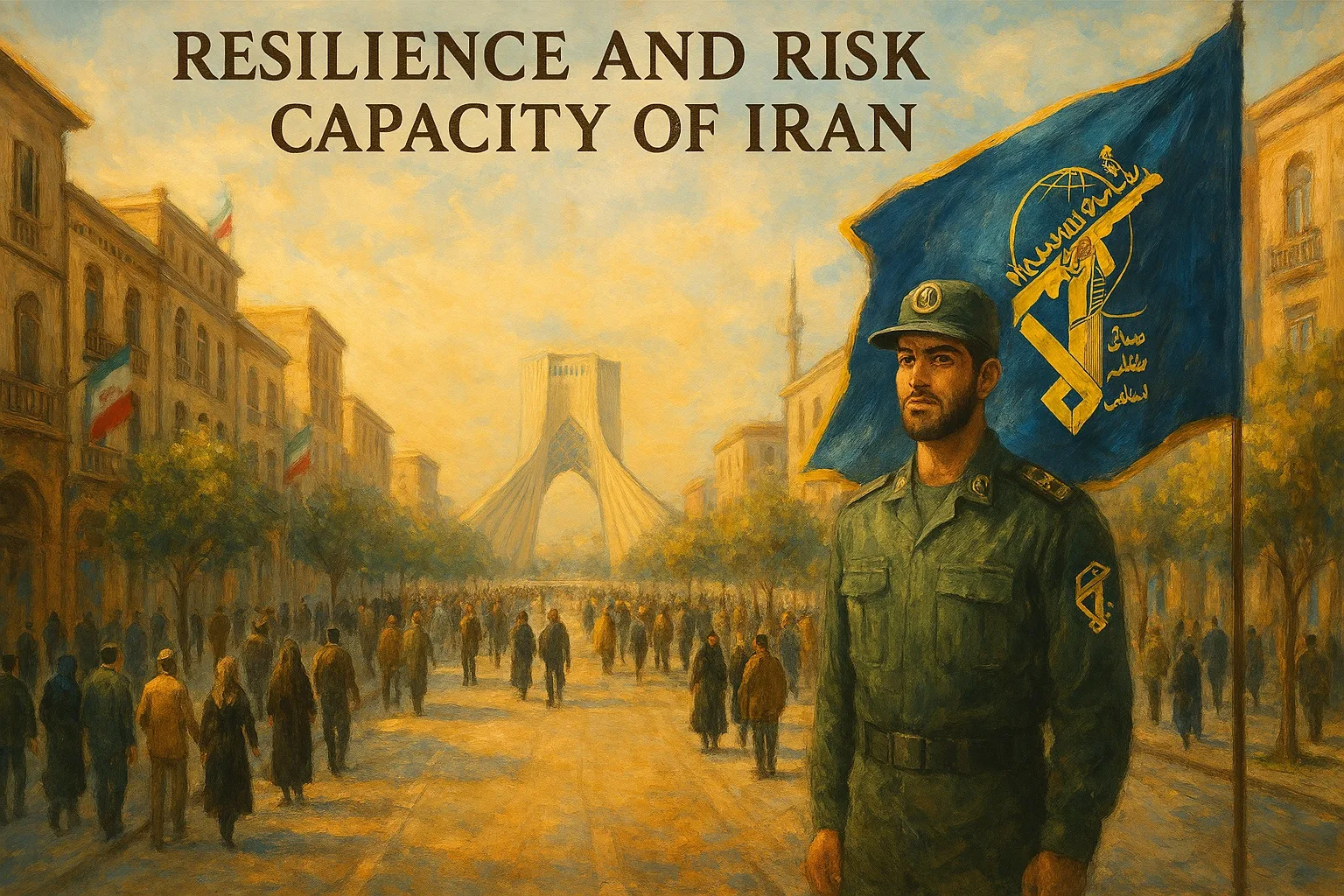
| The war in the Middle East clarifies the risk profile of the three main players present in the region: Iran, China and the USA with its military fleet. In this second part of a mini-series, I outline aspects of Iran’s risk profile – their resilience and risk capacity. | In this text I express my own opinion, not that of any organization. |
Author: Manu Steens
Table of contents
A. Financial resilience — How well can Iran absorb the economic consequences
Iran has learned to adapt economically through decades of sanctions. Since 2018, the United States and the European Union have imposed sanctions on the Iranian oil sector. Nevertheless, Iran managed to stabilize its oil exports again and even increase them through secret black market channels. In 2025, Iran exported an average of approximately 1.5 to 1.6 million barrels of crude oil per day. That is much more than the low point of 444,000 barrels per day in 2020. Oil revenues remain important: they account for approximately 25% of Iran’s GDP and also constitute a large part of government revenue.
In addition, Iran sought to become less dependent on oil. The country focused more strongly on self-reliance and on exports outside the oil sector. These non-oil exports grew to more than 50 billion dollars. The share of non-oil in total trade also rose from 27% in 2011 to 78% in 2020. Domestically, gasoline production increased from approximately 54 million liters per day in 2011 to approximately 120 million liters per day in early 2025. Iran’s geographical location also helps: the country is not entirely dependent on a single border, port, or sea route. It uses road and rail trade routes through Iraq, Pakistan, Turkey, and Central Asia.
But this resilience comes at a high price. Inflation remained above 40% in 2025, meaning that life for ordinary people became more expensive rapidly. The Iranian rial has lost more than 90% of its value since 2018. Sanctions have cost Iran an estimated 300 to 450 billion dollars in oil revenues over the past decade. According to the World Bank, GDP contracted by 2.7% in 2025/26. The economy was also weakened by protests, strikes, and a nationwide internet blackout in the final quarter. At the end of 2025, the reintroduction of UN snapback sanctions added extra pressure.
Assessment: Iran has demonstrated more financial resilience than one would expect based on conventional economic expectations. Nevertheless, this system operates at a low economic level. The regime, and especially the security apparatus, remain standing, but the population bears the heaviest costs. The country survives financially, but ordinary Iranians pay for this with lower incomes and a lower standard of living.
B. Social and emotional resilience — How well can Iran cope with social and political stress
From the regime’s standpoint, Iran’s social resilience stems primarily from control and coercion. It is based less on broad popular support. The Real Instituto Elcano concludes regarding the 2025-26 protests that stability was maintained through control, fragmentation, and adjustment, not through consent. In other words, the system persists because complaints are managed, not because they are actually resolved.
At the end of 2025 and in the beginning of 2026 protests erupted in Iran . These were triggered by economic decline and a loss of currency value. The protests spread across all 31 provinces and constituted one of the broadest mobilizations since the ‘Woman, Life, Freedom’ movement of 2022. According to the International Crisis Group, state troops killed several hundred protesters and arrested thousands. Almost the entire internet was also shut down. To date, the security services, including the IRGC and the Basij , have remained loyal to the regime. There have been no reports of defectors. That loyalty is crucial for the survival of the regime.
Iran International warns that prolonged economic exhaustion and a broader loss of confidence in the Iranian state could make 2026 the most difficult year ever for the Islamic Republic. That loss of confidence is also linked to military and foreign policy setbacks in 2025. An article in The Atlantic stated that five key conditions for a revolution were nearly present: a fiscal crisis, divided elites, a broad opposition coalition, a strong narrative of resistance and a favorable international climate. Yet, opposition groups remain divided and poorly coordinated.
Assessment: Iran’s societal resilience rests primarily on the strength of the security apparatus, not on popular legitimacy. The key question is whether the security services will remain loyal. If the economy deteriorates further and the loyalty of those security services begins to break, the regime will be much less able to deal with protest and resistance.
C. Stability Threshold — How much risk can Iran bear before plans derail
Iran’s strategic plans were already severely disrupted in 2024 and 2025. Hezbollah and Hamas weakened, the Assad regime fell, and Israel attacked Iranian air defenses and ballistic missile infrastructure. In June 2025, there were also American-Israeli attacks on Iranian nuclear enrichment sites. Together, these events dealt heavy blows to Iran’s regional strategy and its deterrence. The Congressional Research Service notes that these setbacks raise doubts about the feasibility of Iran’s strategy: exerting pressure on Israel and the United States while simultaneously deterring direct attacks through regional armed groups.
However, Iran cannot simply be compared to countries like Libya or Syria. According to the Chandragupta Institute, Iran maintains a unified military command, a layered internal security apparatus, and a political system specifically designed to withstand both external pressure and internal unrest simultaneously. In the past, external military pressure has often not broken Iran, but rather temporarily provided it with greater cohesion by stirring up nationalist sentiments. This means that the stability threshold in the face of external threats may be higher than expected, even though the regime’s social contract with the population is under severe pressure.
The real limit likely lies in three problems occurring simultaneously. First: an economic collapse that prevents the regime from adequately funding the security apparatus. Second: the disintegration of the security services, causing the regime to lose its primary means of coercion. Third: a credible opposition capable of organizing the population’s discontent. Iran International argues that those in power in Tehran seem to believe that maintaining coercive power is more important than the risk of popular anger. That calculation works only as long as the security apparatus remains loyal, even as the economy deteriorates further.
Assessment: Iran’s plans have already been partially derailed by the events of 2024-25. The country is now primarily in a damage control phase. The stability threshold is lower than in recent decades because Iran is simultaneously under pressure financially, in its regional network, in its deterrence capacity, and in its relationship with its own population. The regime is still surviving, but its strategic ambition has clearly diminished.