
How to turn intelligent failures into a driver of innovation and flourishing
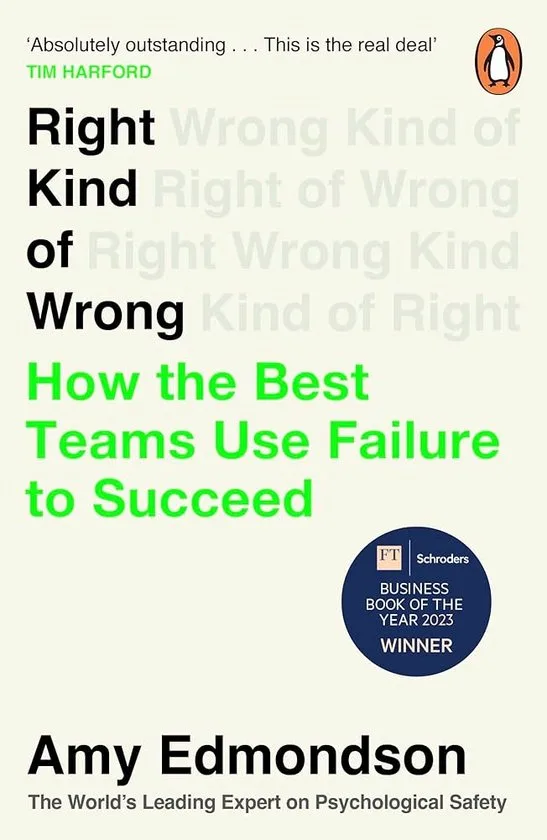
Summary of ‘Right Kind of Wrong’ by Amy C. Edmondson, pioneer of psychological safety
Not every error is the same. Some can and should be avoided. Others are valuable because they teach you something you could not have discovered any other way. The art of ‘getting failure right’ lies in preventing the first kind, embracing the second and learning from both. That only works in an environment where people dare to discuss mistakes and where asking questions is appreciated: an environment with psychological safety.
Table of contents
1. Key terms
| Term | Meaning |
| Failure | The result deviates from the desired result. It is a lack of success. |
| Error | A mistake: an unintended deviation from predefined standards (procedures, rules, policy). |
| Violation | Someone deliberately deviates from the rules. |
Beware: superficial lessons such as ‘I just have to try harder next time’ are cultural beliefs without real consequences. Reflecting on what happened is part of self-management and of getting failure right.
2. Why is getting failure right so hard?
There are three barriers: aversion, confusion and fear.
Aversion. A negativity bias and loss aversion make us notice failures faster than successes. Guilt plays a part, and we prefer to avoid confronting our own failures rather than analysing them. Resilient people explain failures in a more balanced way, do not let shame take over, observe more objectively and keep learning. Perfectionism, by contrast, has pitfalls.
Confusion. In a new context, intelligent failures are part of the process (‘fail fast, fail often’) until you find something that works. Yet the amygdala triggers fight-or-flight reactions regardless of whether the context is new or familiar. A typology of failures helps build a healthy view of them.
Fear. Out of fear of stigma and rejection, we do not talk about failures. We think others like us better if we have no failures, but people are more interested in those who are sincere and genuinely interested in them. Moreover, small failures grow into big problems when nobody reports them. Only a small share of failures is blameworthy, yet many failures are blamed by those who matter in the organisation. That gap leads to concealment.
| Barrier | What goes wrong | What helps |
| Aversion | Bias, guilt, avoiding confrontation | Reframing and building healthy views: recognise biases and be honest with yourself |
| Confusion | Unclear which kind of failure it is | A framework to distinguish types of failure |
| Fear | Stigma and social rejection, hence concealment | Psychological safety |
Psychological safety helps to prevent avoidable failures, to pursue intelligent failures, to remove barriers, to take on new challenges and to try to succeed or else learn from the attempt. It is especially useful where teamwork, problem solving and innovation are needed. Three actions help: experiment in a controlled environment, remove fear because everyone’s input is crucial, and hold evaluative conversations. Failing is never fun, but practice makes it less painful. Reframing a failure as a bronze medal (glad to be on the podium) rather than a silver one (unhappy without the gold) also helps.
3. Three kinds of failure
The kind of failure is linked to the context: consistent contexts tend to go with basic failures, variable ones with complex failures and new ones with intelligent failures. The link can also run across categories.
| Kind | Context and example | Characteristics | Approach |
| Basic failure | Consistent, well-developed knowledge, low uncertainty. Example: car assembly line. | Familiar territory, a single cause (inattention, negligence, overconfidence). Most avoidable and least productive, but sometimes just as disastrous as a complex failure. | Prevent, report, correct. Checklists and training, used ‘with the brain switched on’. |
| Complex failure | Variable, well-developed knowledge but prone to the unexpected. Example: operating theatre. | Familiar setting, multiple causes, often subtle warnings beforehand, at least one seemingly uncontrollable factor, sometimes overconfidence. | Look for the interplay of factors, not a culprit. Take warning signals seriously. |
| Intelligent failure | New, limited knowledge, high uncertainty. Example: scientific laboratory. | New territory, a chance of success, based on existing knowledge, experiments as small as possible. | Enter deliberately, keep the experiments small, share the learning widely. |
Intelligent failures: the good kind
Success in new territory depends on the willingness to tolerate this kind of failure. Edison put it this way: “I have not failed. I’ve just found 10,000 ways that won’t work.” A failure is only intelligent if no method or manual exists to solve the problem. The notes give four criteria, which are not a litmus test but always call for judgement:
- it happens in new territory;
- there is a worthwhile opportunity to reach the goal;
- it is based on available knowledge (hypothesis-driven);
- the failure is as small as possible but can still yield valuable insights.
Bonus: you learn from it and share that widely in the team or organisation.
Do your homework first: read up on the subject, formulate a good hypothesis and think about what could happen. Keep it small: experiment in a contained environment, stop when it clearly does not work (beware of the ‘sunk cost fallacy’), acknowledge a failure in good time so that resources are freed up, and share what does not work. Be careful when scaling up, because conditions change. A pilot is meant to expose weak spots, not to prove success to senior leaders. So test under normal or preferably challenging conditions, do not base rewards and performance reviews on the success of the pilot, and implement the changes that follow from it.
Really learn from it. Avoid three attitudes: skipping the analysis (‘I’ll just try harder next time’), analysing superficially (‘it didn’t work, I’ll try something else’) and analysing to protect your own position (‘I was right, someone messed it up’). Instead ask: what did I want to happen, what actually happened, and what caused the difference? This turns disappointment into curiosity.
Basic failures: prevent them
Basic failures are everyday events and usually have no major consequences, but they should be avoided as much as possible. A checklist offers basic structure but is dangerous when applied blindly without looking at the context. Wrong assumptions (‘we’ve always done it this way’) feel like facts and are therefore hard to avoid. People quickly place blame on others or on circumstances, whereas adjusting your own behaviour is the most efficient route. Prevention only works if reporting your own failure is not punished, while a deliberate violation is. Reports are best made in writing on an official form, describing the chain of events, the correction and the human factors. Postponing is not an option: procrastination leads to damage.
Complex failures: an interplay of factors
With complex failures, looking for individual culprits is not only unhelpful but inaccurate, because several small factors combine so that a failure slips past the safety measures. Pitfalls include a sense of familiarity, missed signals and interactive complexity in a changing environment. People downplay ambiguous threats through confirmation bias: they see what they expect or want to see. It is therefore worth welcoming every false alarm and thanking people for it, as the villagers should have done with the shepherd who cried ‘wolf!’.
As an example of a good approach, the notes cite high reliability organisations (HROs). They are characterised by a preoccupation with failure, reluctance to simplify, sensitivity to operations, commitment to resilience (recording and correcting errors rather than expecting a flawless course) and deference to expertise over rank. The idea of ‘normal accidents’ teaches that it is better to improve the system than to replace people in a poorly functioning system.
4. Your own reaction to failure
A failure threatens the ego. As a result, people perform worse on a next attempt after negative feedback than after positive feedback. They learn less from their own failures than from their successes, but equally from the failures and successes of others. According to the notes, shame is associated with, among other things, depression and aggression, while guilt shows the opposite relationship. It helps, then, to think ‘I didn’t get it; what can help me get it next time?’ rather than ‘I am a failure’. Social media also contribute, by constantly exposing us to the success and perfection of others.
Two frameworks from the notes matter here. Carol Dweck contrasts the fixed mindset (fear of looking stupid, avoiding new challenges) with the growth mindset (challenges make you smarter; respond with curiosity and determination, not to be confused with stubbornness). Chris Argyris contrasts rational with irrational thinking: non-learning behaviour stems from the idea that you must always be right to be a worthwhile person. A learning framework is healthier and more rational than a performance framework. ‘Learning’ ranks above ‘knowing’, because you can know something wrongly.
Rational behaviour therapy (RBT) offers three habits for responding to a failure:
- Pause: wait so that the automatic emotional reaction can settle. Ask yourself what is going on right now.
- Think critically: examine your spontaneous thoughts. What objective data support or contradict your interpretation, and is another interpretation possible?
- Choose: say or do something that brings you closer to your goal. What do I really want?
There is no eureka moment here: repeated practice delivers results.
5. Context and systems
Know the context. In new territory you do not know the solution, yet we often feel we should. Ask yourself: how much is known, and what is at stake? Consequences can be physical, financial or reputational, with high or low stakes. Few contexts are truly consistent, and something new is often underestimated, for instance when it is treated as an ordinary execution task. Anyone who, through naive realism, thinks they see reality rather than seeing through a cognitive lens becomes overconfident and makes avoidable failures. Make it a habit to determine where you sit on the scale from consistent through variable to new, what is at stake and whether you have done your homework.
Think in systems. A system consists of elements and the relationships between them. Failures often have several causes, yet we often look for just one. Those who look at the relationships can better foresee and prevent failures, and also do not feel fully and solely responsible when one occurs. Systems thinking also means looking from ‘here and now’ to ‘elsewhere and later’: who and what is affected by my decision? Ad hoc solutions are satisfying but make the system worse, because they do not reduce how often the problem occurs. A second-order solution, involving the SME or line manager, does. Urgency often leads to putting a ‘plaster on a broken leg’, so prioritise what matters most and say no to the rest.
Report without blame. Do not assume someone is at fault, otherwise facts get swept under the carpet for fear of punishment. Practical tips from the notes:
- Use neutral words: ‘study’ rather than ‘investigation’, ‘what makes that’ rather than ‘why’.
- Use focus groups to identify all causes and watch for non-verbal signs of hesitation.
- Document findings and share them anonymously across the organisation.
- Set up action teams for safety and keep a log of good catches (near misses).
6. A culture that learns
Failures are not a matter of if, but of when and how. Self-acceptance and honesty with yourself are the first step towards being honest with others. Those who play to win take risks, those who play not to lose avoid them all. Research shows that people afterwards do not regret a failure, but regret not having tried. So dare to take (calculated) risks: you will have more failures, but you realise you won’t die from them and you build mental muscle.
As a manager, you do not praise the failure, because it is seen as an endpoint, but the course correction. The right words matter. Report failures early rather than late, because that saves costs. Reward openness, but not sloppiness. And if people have to be dismissed, preferably start with those who have never had an (intelligent) failure. A healthy culture shows itself in reports of everything that goes badly: bad news, problems, disagreement and ‘I need help’ belong there just as much as good news, progress and agreement.
Managers build psychological safety by having everyone ask themselves three questions every day (if the answers are ‘yes’):
- Am I treated with dignity and respect, every day, at every encounter, regardless of race, ethnicity, nationality, gender, religion, sexual orientation, title, salary grade or number of degrees?
- Do I have the resources I need (education, training, tools, financial support, encouragement) to make a meaningful contribution?
- Do I receive recognition and thanks for what I do?
Getting failure right requires honesty, curiosity, rationality, determination and passion. The boundaries between the kinds of failure cannot be drawn sharply and call for judgement and experience: how new must new territory be, how well-founded must a hypothesis be, how high are the stakes and how do you assess uncertainty?